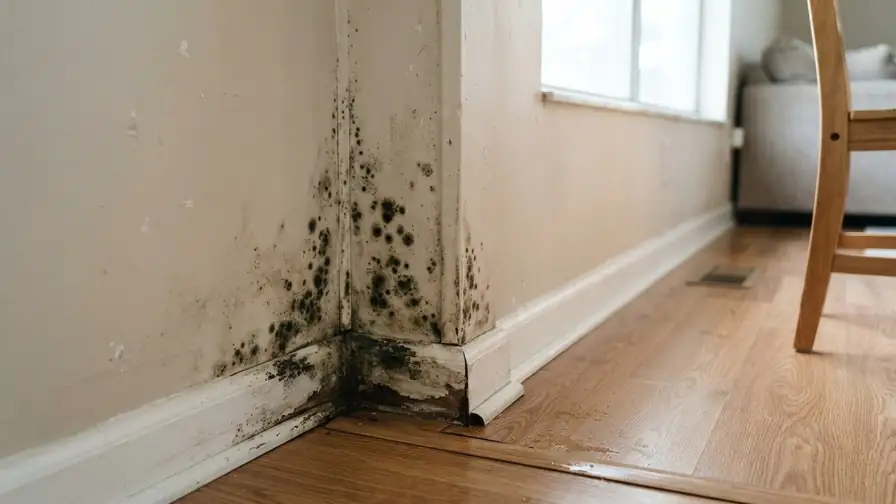
Few household phrases cause as much worry as black mold. News stories and online videos make it sound like a single deadly organism. The reality is more ordinary, and more useful: many molds look dark, and the cleanup depends on how much there is and what it is growing on, not on its color.
Official source
For plain information on mold and health, see the Florida Department of Health mold page.
Is all black mold toxic?
No. Many molds look black, and color does not tell you the species or whether it produces mycotoxins. Any mold can cause symptoms in sensitive people, so significant growth should be removed safely regardless of color, and health questions should go to a doctor.
Related service >>
- Black Mold Removal in Lakeland, FL
Many Molds Are Black
The mold most people mean by black mold is Stachybotrys, a slow-growing species that needs material to stay wet for a long time, such as drywall paper soaked by a leak. But plenty of other common molds, including some Cladosporium and Aspergillus species, also look dark green or black. You cannot tell them apart by eye.
That is why a dark stain is a reason to investigate, not a reason to panic. What it does tell you is that something stayed wet long enough to support growth. In a Lakeland home, that often points to a slow plumbing leak, an AC condensate problem or a roof leak that went unnoticed through a stormy summer.
Health Questions Belong With a Doctor
Any mold can trigger symptoms in sensitive people, such as stuffy nose, coughing, itchy eyes or worsened asthma. People with weakened immune systems or chronic lung conditions can be more at risk. If anyone in your home has symptoms, talk with a doctor, who can advise you based on your health history.
A mold provider can tell you what is growing, how much and why. They are not the right source for medical advice, and you should be cautious of anyone who uses health fears to push a larger job. The Florida Department of Health has plain information about mold and health that is worth reading.
What Actually Sets the Cleanup Plan
The approach comes down to how big the affected area is and the materials. Small patches on hard surfaces can sometimes be cleaned. Growth on drywall, insulation or carpet usually means cutting out and bagging the material under containment, with a HEPA air scrubber running. The wall cavity behind it is checked and cleaned, and the framing is dried to normal moisture readings.
Most important, the water source has to be fixed. A dark patch near a baseboard often traces back to a supply line, a toilet seal or water wicking up from a damp slab edge. Without that repair, the growth will return no matter how well the surface is cleaned.
Staying Calm and Getting It Checked
If you find dark growth in your Lakeland home, leave it undisturbed, keep the area dry and have it looked at. A careful inspection will find the moisture source and size up the job. From there, the cleanup follows the same proven steps used for any significant mold problem.