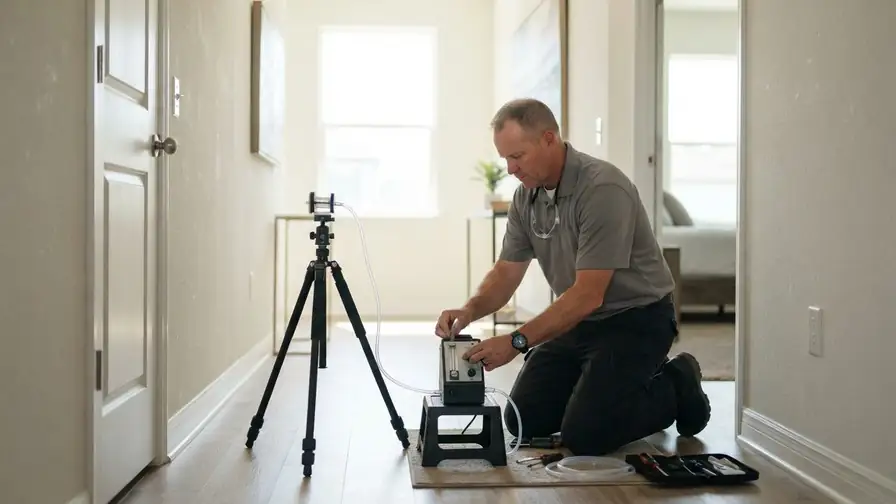
If you smell mold but cannot see it, or you see something and want to identify it, testing can help. But mold tests answer specific questions, and the wrong test can leave you with a lab report that says very little. Here is how the common methods compare for a Lakeland house.
Do I need mold testing if I can see the mold?
Often not. If growth is visible, the cleanup plan is based on its size and the materials affected, not the species. Testing can still help document conditions or check for hidden growth elsewhere, but it is not always required before removal.
Related service >>
- Mold Testing in Lakeland, FL
Air Samples Tell You What Is Floating Around
An air sample pulls a measured volume of air through a cassette called a spore trap. The lab counts the spores and identifies the general types. The key is the outdoor control sample, taken outside the house at the same visit. In a humid place full of lakes and trees, outdoor air always has spores in it, so an indoor number only means something when compared with the outdoor one.
When indoor counts are much higher than outdoor counts, or show types that are rare outside, something is likely growing inside. Air samples are useful for hidden problems, after a leak inside a wall or as part of a clearance check after cleanup.
Swabs and Tape Lifts Tell You What Is on a Surface
A swab or a strip of clear tape pressed against a stain lets the lab confirm whether a spot is mold and roughly what kind. This helps when you are not sure whether a dark area is mold, dirt or soot, or when you want to document growth before cleanup.
Surface samples do not tell you how far growth has spread or what is in the air. They also do not change the cleanup method much, since the approach is set by the size of the area and the materials involved, not the species. Use them to answer a yes or no question about a specific spot.
Building a Sensible Test Plan
A good inspector starts with a visual inspection and moisture readings, then picks samples to answer a clear question. For a musty bedroom with no visible growth, that may be one indoor air sample, one outdoor control and maybe a wall cavity sample. For a visible patch, testing may not be needed at all, because the plan is to remove it either way.
Be wary of anyone who wants to take a long list of samples without explaining why. More samples cost more and rarely change what happens next. Ask what each sample is meant to show, and how the result would change the recommendation.
When Testing Is Worth It
Testing makes the most sense when you suspect hidden growth, want a baseline before buying a home or need to confirm a cleanup worked. If you can already see the problem, the money may be better spent on fixing the moisture and removing the growth. An independent inspector can help you decide which applies to your Lakeland house.